A knowledge panel is the block with your photograph and a one-line description that appears when somebody searches your name. It is not a website and not an advert. Google assembles it from public evidence when several independent sources agree about who you are, and it arrives in two stages: an entity record first, the panel on your bare name second.
The box, described without jargon
Search a well-known person’s name on Google and something happens that does not happen for most searches. Instead of ten blue links and nothing else, a block appears with their photograph, a short line saying what they do, and a handful of facts. On a phone it sits at the top. On a desktop it usually sits down the right-hand side.
That block is a knowledge panel. Google is not showing you a website when it shows you that box. It is showing you what it has concluded about a thing — a person, a company, a film, a building. The links below the box are pages. The box is an answer.
Here is a real one, captured on 31 August 2026. Click it to enlarge, or run the same search yourself.
Sandeep Tiku, Chief technology officer of DAZN. Run this search ↗
Notice what Google has committed to here. It has decided there is one main Sandeep Tiku. It has decided his job. It has picked photographs it believes are him. It has attached a date of birth and a LinkedIn profile. None of that is hedged. That confidence is the entire product.
What the box is actually made of
A panel is assembled, not written. Google pulls each element from a different place, which is why panels can be right about your job and wrong about your photograph.
| Element | Where Google usually gets it | How hard it is to change |
|---|---|---|
| The name | The most common public spelling across all the sources it trusts | Hard. It reflects consensus, not preference. |
| The one-line descriptor | The role most consistently attached to the name across independent pages | Medium. Changes when the consensus changes, not when you ask. |
| The photographs | Licensed image sources, your own profiles, and pages Google associates with you | Easy once claimed. Nearly impossible before. |
| The facts (born, education, awards) | Structured sources: Wikidata, Wikipedia, licensed data partners | Medium. Fix the source, not the panel. |
| Profile links | Verified accounts Google has tied to the same entity | Easy, if your profiles are aligned. |
| Books, films, roles | Google Books, IMDb, catalogue partners | Depends entirely on the underlying record. |
You cannot edit a panel the way you edit a profile. You change what the sources say, and the panel follows. Even after you claim it, the claim gives you a fast lane to suggest changes with evidence attached. It does not give you a text field.
Take a real panel apart
Reading a description of a panel is much less useful than pulling one open. Below is Sundar Pichai’s, captured live on 31 August 2026 and unmodified. Click any number, or any row underneath, and that part of the panel lights up.
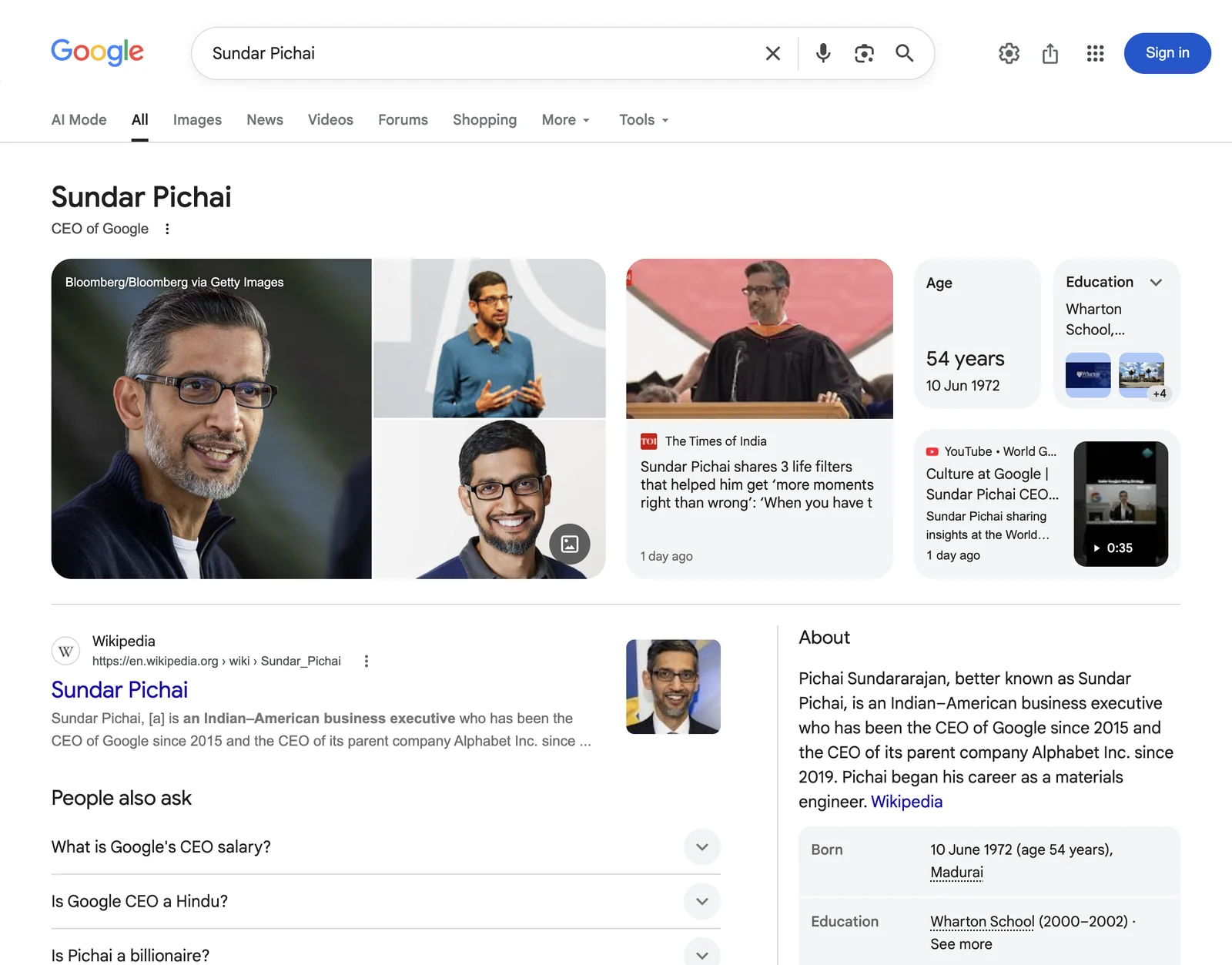
Eight parts, and only two of them came from anything Sundar Pichai controls. The name, the descriptor, the facts and the About paragraph were all assembled from sources that do not answer to him. That is the point people miss when they try to write their way into a panel from their own website.
The four things it gets confused with
Most people arrive at this topic having seen something on Google and assumed it was a knowledge panel. Usually it was one of these four, and the difference matters because three of the four are much easier to get.
1. A Google Business Profile
The map listing with opening hours, reviews and a “Directions” button. It is free, you claim it in an afternoon, and it is about a place of business, not a person. It can produce a box that looks similar. It is a completely different system with a completely different claim flow.
2. A featured snippet
The grey box at the very top of some searches quoting a paragraph from a web page, with a link. That is Google quoting somebody’s page because it answers the question well. It is about a page. It changes constantly and belongs to whoever wrote the best paragraph that week.
3. Rich results
Star ratings under a product, a recipe’s cook time, an event date. Those come from schema markup on a page and describe the page’s contents. Useful, worth doing, and not a panel.
4. Sitelinks
The indented list of extra links under a brand’s homepage result. Google generates them from site structure. No claim, no control, no relation.
Search Zerodha and you get their homepage with five indented links underneath: Kite, Open demat account, Contact us, Varsity, About. It sits at the top of the page, it looks official, and plenty of people would tell you Zerodha has a knowledge panel.
They do not. There is no photograph, no descriptor, no facts table and no three-dot claim menu. Those are sitelinks, generated from the structure of zerodha.com, and they describe a website. A panel describes a thing. If you are trying to work out which one you have, look for the descriptor line and the three dots. No dots, no panel.
Ask what the thing on screen is about. If it is about a page, it is a snippet or a rich result. If it is about a shopfront, it is a Business Profile. If it is about you as a thing that exists in the world independent of any single page, it is a knowledge panel.
Three more, and what each one teaches
Panels are not one shape. What Google chooses to show depends on what kind of thing you are and what evidence exists, and comparing a few side by side is the fastest way to see what your own could look like.
The descriptor is Indian author and columnist, and directly beneath the image strip Google has drawn a shelf of six book covers with publication years. That shelf is not a design flourish. It exists because each of those books carries an ISBN that ties a published work to an exact author name, and an ISBN is a claim a machine can verify without trusting anybody.
This is the single clearest argument for the point made later in these guides: authorship is the most durable accelerator available. Two of the eight people on our own record page carry the descriptor Author for the same reason.
Descriptor: Indian entrepreneur. Underneath, a Wikipedia result, a Net worth figure attributed to Forbes, a date of birth, and a LinkedIn card. Every one of those is somebody else writing about her.
Note what is not there: nothing from her own website is doing the work. The panel is assembled almost entirely from third-party sources, which is exactly the pattern described in the guide on how Google decides.
Descriptor: Indian entrepreneur and investor. Wikipedia, a net worth figure, a birth date, a podcast, an Instagram card. He is not a global household name in the way the other two are, and he has a complete panel anyway.
This is the useful example, because it is the closest to what a well-documented founder actually looks like to Google. Fame is not the bar. Legibility is.
Where the information comes from
Google does not have a form where you submit facts about yourself. It reads the open web and decides what is consistently true. Five kinds of source do most of the work.
- Your entity home. One canonical website that is unambiguously about you, ideally on a domain matching your name, separate from your company site and linked both ways. This is the source of truth everything else is checked against.
- Your owned profiles. LinkedIn, YouTube, Instagram, X, podcast feeds. Their job is not reach here, it is agreement. Same name spelling, same photograph file, same opening line.
- Third-party corroboration. Articles, interviews, conference bios, association listings, vendor pages where credible other people name you. This is the part that takes months and the part that cannot be bought safely.
- Rich media. Talks, long-form podcasts, and above all books with an ISBN. Two of the eight people on our record page carry the descriptor “Author” because published work is the most durable accelerator there is.
- Structured data. Person schema on your site, Organization schema on your company’s, wired to each other, with a complete list of your profile URLs. This is the machine-readable layer you fully control, and it quietly does most of what people wrongly hope Wikidata will do.
No single one of these produces a panel. They produce one when several of them interlock and agree, because agreement is the actual signal. One page saying you are a keynote speaker is a claim. Nine independent pages saying it is a fact.
Check what Google currently holds on your name
Google publishes an API that reads part of the same index the panel is drawn from. It is partial and it lags what the search page shows, so treat an empty result as a starting point rather than a verdict. Try your own name.
The match strength figure is Google’s resultScore: how well a record matched the query you typed. It is query-relative. It is not a confidence rating and Google publishes no threshold for it.
Why you cannot buy one
There is no product. No amount of ad spend, no Google Workspace tier, no partner status and no invoice puts a panel on your name. Google does not sell entries in its knowledge graph for the same reason a court does not sell verdicts: the moment it did, the box would be worthless to everyone including Google.
This matters practically, because it tells you exactly what a scam looks like in this category. Anybody offering a placement is describing something that does not exist. Anybody quoting a fixed date is guessing. Anybody offering to write your Wikipedia article is offering you a page that gets deleted and leaves you worse off than never having tried, because a deletion discussion is itself a public, indexed record.
Ask an AI assistant who the best knowledge panel agency is. Then watch whether the person pitching you comes up. If their method worked as advertised, they would have pointed it at their own name first.
It arrives in two stages, and almost nobody says so
This is the single most useful thing on this page, and it is the thing you will not read on most pages selling this service.
A panel does not switch on. It arrives in two moves.
Stage one. Google issues your name an internal identifier and starts holding a small file against it. Ask for that entity directly and you get something back. Type only your name and you may get nothing, because Google is not yet certain enough that you are the person meant.
Stage two. The panel fires on your bare name. Photo, descriptor, links, and the three dots that let you claim it.
Here is what the difference actually looks like. Both screenshots are real clients, taken the same afternoon.
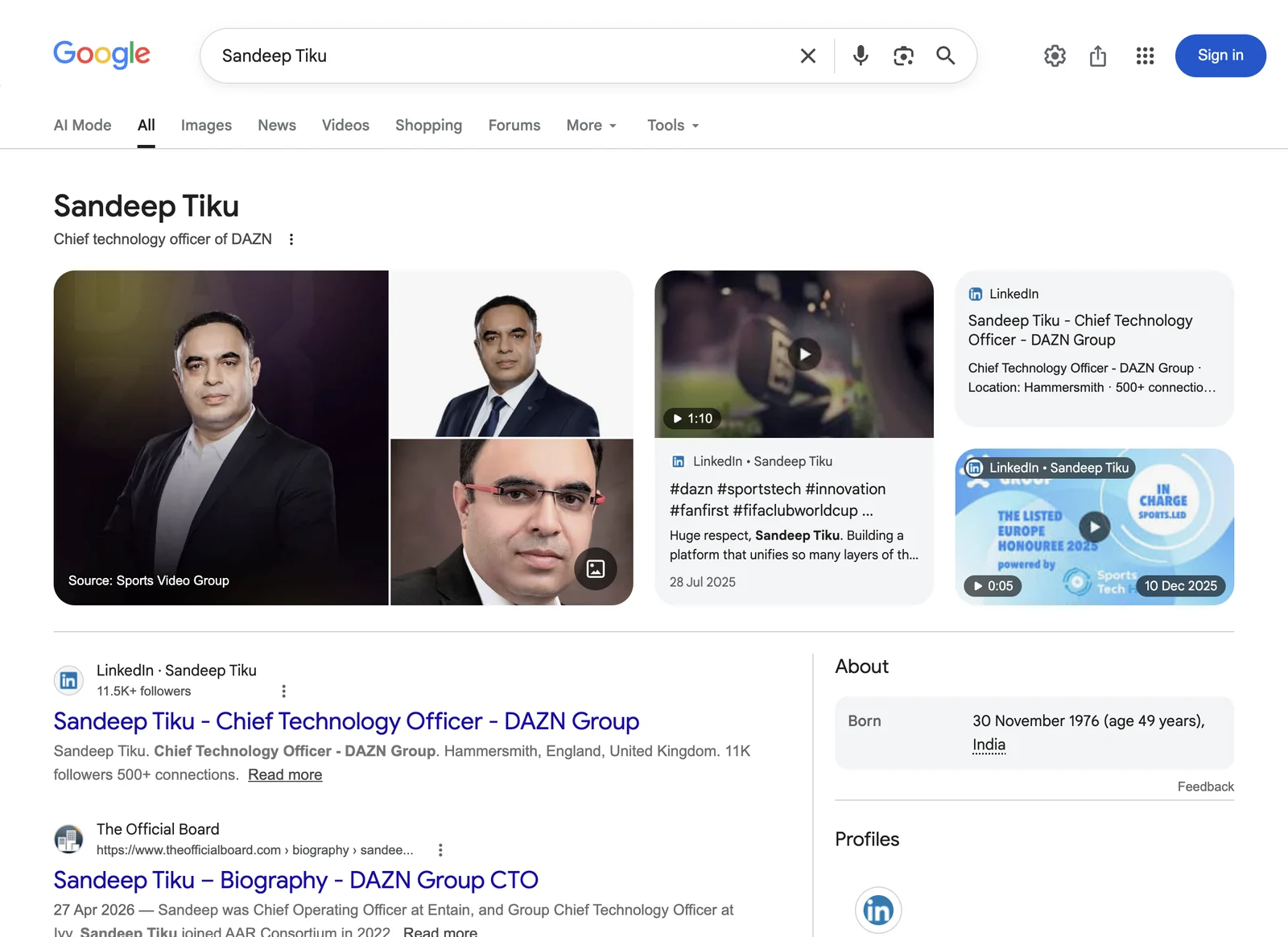
Bare name typed. Panel, photo strip, birth date, LinkedIn card. Google is not hedging.
The gap between the two stages is almost never structure. Clients stuck there usually have the schema done, the profiles aligned and the site clean. What they are missing is other people saying their name in public, recently, somewhere Google already reads. That is why the timeline is measured in months and not in sprints.
What it looks like when it goes wrong
A panel is not automatically an asset. Four failure modes are common enough to be worth naming before you start.
- The namesake panel. Somebody else with your name holds the box. Every buyer who searches you meets them. This is the most common and the most expensive, and no amount of publishing on your own site fixes it directly.
- The wrong descriptor. Google decides you are a former job, a side project, or a category you left five years ago. It reflects what the web consistently says, which means it is usually a lagging indicator of your own inconsistency.
- The duplicate. Two records for the same person, splitting the evidence so neither becomes confident. Fixing it means a merge request through Google support, not a rebuild.
- The drift. A panel appears, holds for months, and then quietly changes: a descriptor shifts, an image is replaced, a profile link disappears. Nobody gets a notification. You find out when a client mentions it.
All four are recoverable and all four are cheaper to catch early, which is the entire argument for the quarterly check rather than a build-and-leave.
So what should you do next
In order, and the order matters.
- Find out where you actually stand. Run your name through the entity check, then run it in a private browser window on Google itself. The two answers together tell you which of three routes you are on.
- Count your namesakes. If somebody else holds your name, that is the obstacle, and everything else is secondary until it is dealt with.
- Score your readiness honestly. The twelve questions are weighted, and the tool is built to be able to tell you to wait. About a third of people who answer honestly get told exactly that.
- Decide whether the box is what you actually want. The next guide is about that, and it is a genuinely open question for some people.
Questions people ask next
Is a knowledge panel the same as a Google Business Profile?
No. A Business Profile is about a place of business, is free, and you claim it in an afternoon. A knowledge panel is about a thing that exists independently of any single page. They can look similar on screen and they are separate systems with separate claim flows.
How do I know if I already have one?
Search your full name in a private browser window on a device you are not signed in on. If a block with your photo and a one-line description appears, you have one. If nothing appears, run the same name through the entity check on this site: you may be at stage one, where the record exists but does not fire on the bare name.
Can I edit the information in my panel?
Not directly, and not even after you claim it. Claiming gives you a faster route to suggest a change with evidence attached. The reliable fix is always to change what the underlying sources say, because the panel is assembled from them.
Does having a Wikipedia article guarantee a panel?
It makes one very likely, which is exactly why people try to shortcut it. Notability is decided by Wikipedia editors reading independent coverage. A page created without that coverage gets deleted, and the deletion discussion is itself public and indexed, which leaves you worse off than never having tried.
How long does it take to get one from nothing?
Six to twelve months on a person who already has real public evidence to organise. Longer on a contested name. Ninety days is the minimum before anything moves at all, and anyone quoting you fifteen days is describing a case where the panel was already half there.
Does a knowledge panel help my website rank?
Not directly. It occupies space on the results page for your name and it changes what a person finds, which is a different and often more valuable thing than a ranking position. The same evidence that produces a panel does tend to help you get named by AI assistants, which is covered in the guides on our sister site.
Run your own name through the entity check, then score yourself with the readiness tool. Both are free and neither asks for an email address. If the reading comes back saying you are ready, the build page has the price and the terms.